
Reverse mortgage after death
What heirs do when the borrower on a HECM, the FHA-insured reverse mortgage for homeowners 62 and older, dies.

A reverse mortgage after death leaves your family 3 clear choices: sell the house, pay off the loan or hand over the keys. This debt never has to come from your own pocket. The lender gives you a fixed period to review the balance and make a choice. When the home's value is higher than the loan, you keep the extra cash after a sale.
What happens to a reverse mortgage when you die?
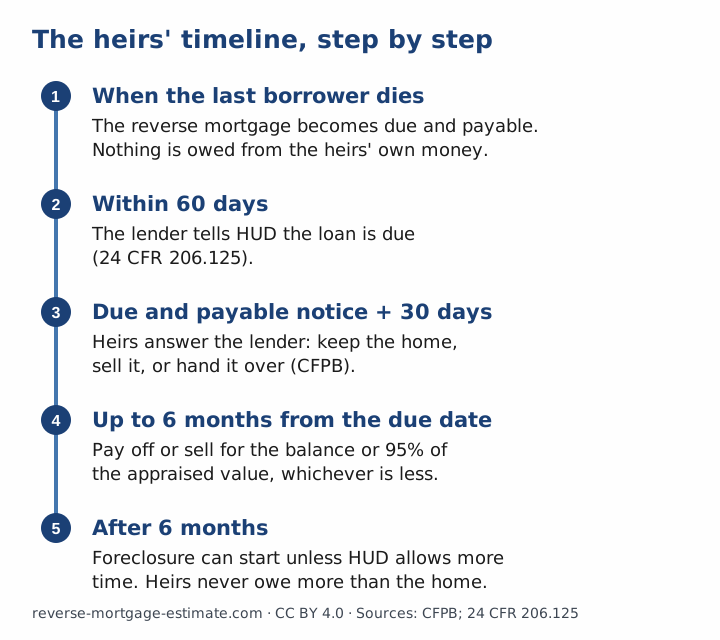
Once the last borrower dies, the full loan becomes due and payable, so it must be settled right then. It also applies when the home gets sold or stays empty for more than 12 months. The homeowner made 0 monthly payments while the loan was open. What grew the balance instead was a median 6.0% interest charge plus a 0.5% yearly mortgage insurance fee. See how a reverse mortgage works during the time the owner lives at home. Interest continues to build after death until your family closes out the loan.
Paying off a reverse mortgage: the timeline and what heirs can do
The lender mails a formal notice to the relatives who inherit the property. Once reverse mortgage heirs have that letter, they get 30 days to buy the home, sell it or turn it over. These 3 ways for families to pay off the loan come from the Consumer Financial Protection Bureau. On sites like Reddit, people often ask who has to pay the loan after a parent passes away. The debt is backed only by the home, so relatives never face a bill in their own name. There's also no way around paying the required payoff amount if you want to keep the house.
Can you explain the 95% rule that applies to reverse mortgages?
If the loan balance climbs past the home's market value, federal rules protect you. You repay the smaller of two sums under CFPB rules for heirs: 95% of the appraised value or the entire balance. You pay a 2% upfront insurance fee on a home value up to the HUD HECM limit of $1,249,125 in 2026, or $1,209,750 in 2025. When 95% of the appraised value is lower than the debt, that insurance fund covers the lender. Try our reverse mortgage amortization calculator to watch a balance increase over time.
| Family choice | If the loan is smaller than the home value | If the loan is larger than the home value |
|---|---|---|
| Keep the house | Pay the full loan balance | Pay 95% of the appraised value |
| Sell the house | Use the sale money to pay the full loan balance and keep everything above it | Get at least 95% of the appraised value when you sell. |
| Turn the house over | Sign the property over and pay $0 | Sign the property over and pay $0 |
What protects a spouse who stays in the home
Sometimes only 1 spouse put their name on the loan, so the other spouse lives there without being a borrower. A non-borrowing spouse can ask to delay foreclosure for up to 180 days once the borrower has died. Once the borrower and the non-borrowing spouse pass away, heirs are required to pay the balance in full or 95% of the appraised value. Surviving spouses can get free help with lender paperwork from HUD-approved reverse mortgage counselors.
Selling a house with a reverse mortgage
Selling the house is often the simplest way to cover the loan and claim the equity that's left. Under CFPB sale guidelines, you may sell for 95% of the appraised value even after a due and payable notice arrives. Selling the property isn't difficult once you request a written payoff quote from the lender. The loan is paid at closing if the sale price exceeds the balance you owe. Any money left over goes to your family.
Is walking away from a reverse mortgage an option for heirs?
Yes, you can leave the home behind and not take $1 from your own savings. Because these loans are non-recourse, the lender can only recover the home's value and can't go after the family's personal money. Families find that the biggest problem is how upfront costs and interest make the estate smaller. Expect origination fees between $2,500 and $6,000, and third-party closing costs that average about $3,000. You can read our reverse mortgage pros and cons guide. You can walk away by asking for a deed in lieu, which means you sign the property papers over to the lender directly.
Calling a Celink reverse mortgage servicer and stopping foreclosure
After a death, your best move is to call the servicer, the company that mails monthly statements and collects what's owed. Look at your newest statement to find their phone number. Celink, Reverse Mortgage Solutions or Financial Freedom handle many federal loans. A $4.25 million settlement with Celink was announced by the Department of Justice in prior cases about federal servicing rules. That report included a settlement of $29.63 million with Reverse Mortgage Solutions and one of $89 million with Financial Freedom in May 2017. If heirs don't respond within the 30-day window, foreclosure begins. Phone them immediately, provide the death certificate and explain whether you plan to buy, sell or hand back the property. If you're planning ahead, compare reverse mortgage companies.
Questions about your own home? Call (833) 962-5300. A reverse mortgage specialist answers; we are not a lender.